Executive Summary
Sharper messaging turned paid acquisition into qualified demand.
The SaaS company was investing heavily in PPC, but the landing experience was too cluttered, too technical, and too visually flat to convert high-intent traffic efficiently.
This representative case study shows how Laur would restructure the page around trust, hierarchy, and immediate ROI comprehension to increase free-trial sign-ups by 55%.
Headline metric
+55%
Increase in free-trial sign-ups
The leading outcome here is a stronger acquisition page that converts more of the traffic the business is already paying for.
The Business Challenge
Paid traffic was landing on a page that explained features, not value.
The previous landing page had too much noise and too little persuasion. It asked visitors to work through jargon and dense UI before understanding why the product mattered or why it could be trusted.
Weak value proposition above the fold
The page opened with technical copy instead of a concrete business promise, creating unnecessary cognitive friction for first-time visitors.
Buried trust signals
Social proof, proof points, and credibility cues existed, but appeared too late to influence the core conversion decision.
Confusing primary CTA
The call-to-action blended into the rest of the interface and failed to communicate the value of starting a free trial.
The Strategic Solution
The landing page was rebuilt around trust, sequencing, and ROI clarity.
Laur reframed the page as an objection-handling system. Every section was redesigned to answer the next logical buyer question in sequence, while interactive elements helped users understand business value instead of parsing abstract feature lists.
Minimalist trust-centric layout
The interface was simplified to create more contrast between headline, proof, and action, making the first screen feel calmer and more credible.
Sequential objection handling
Information architecture was restructured to move visitors from problem recognition to proof to action without overwhelming them with technical detail too early.
Interactive ROI visualization
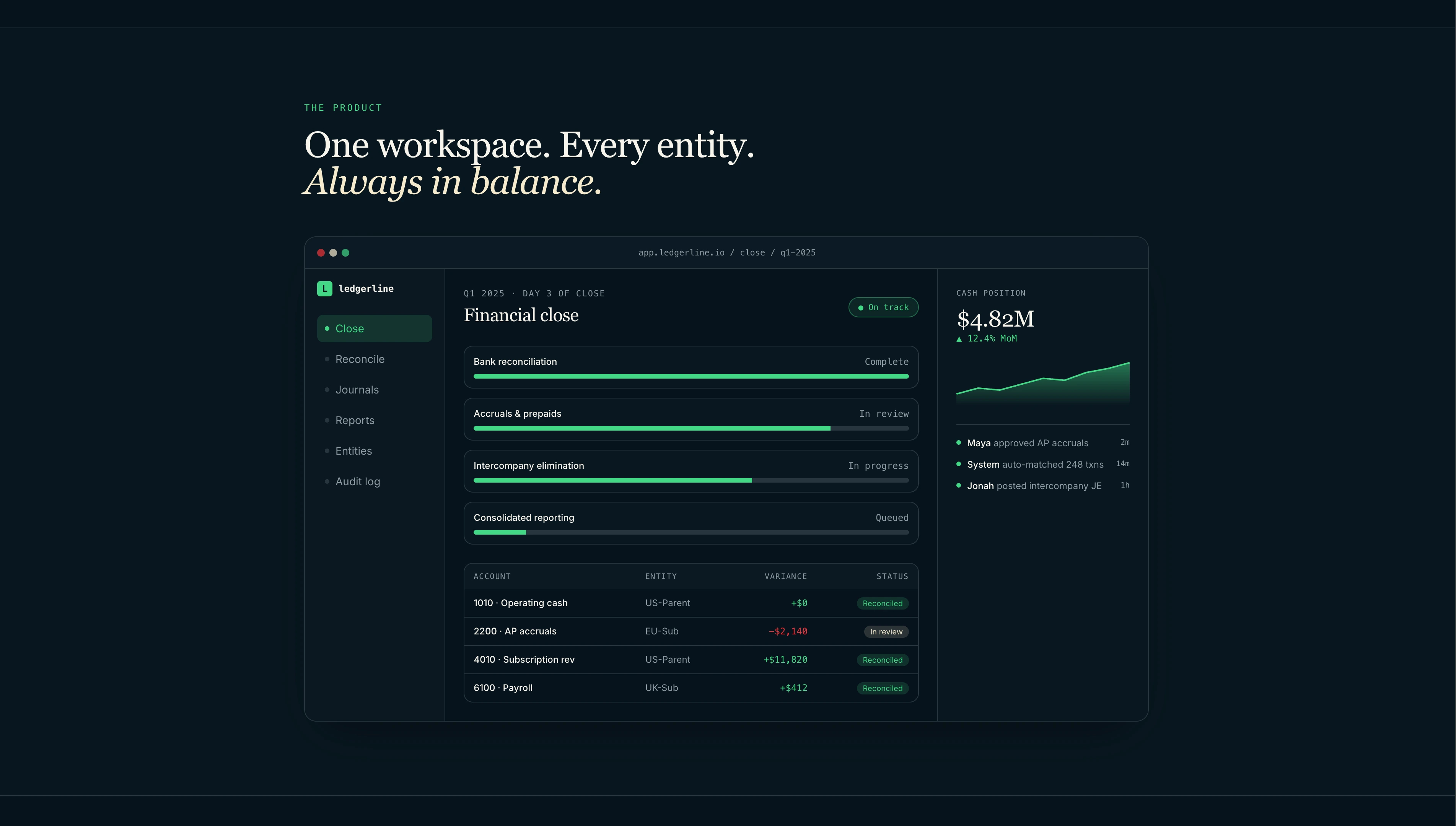
Dense tables were replaced with responsive React modules that made the financial upside of the software easier to understand in real time.
High-Velocity Execution
A three-week conversion sprint focused on message hierarchy first, then build quality.
The delivery model emphasized speed without rushing strategy. The first week established the narrative and wireframe logic, while the remaining time was used to build and refine the production page.
Week 01
Audit, positioning, and wireframes
Review user friction, paid-traffic intent, and conversion barriers, then restructure the page around a clearer acquisition narrative.
Week 02
UI design and interaction planning
Translate the new message hierarchy into a premium, trust-led visual system with responsive behavior across devices.
Week 03
Engineering, QA, and launch
Build the page, implement the interactive ROI modules, and polish the experience for deployment and post-launch testing.
Tech Stack
A focused front-end stack supported rapid iteration and conversion testing.
The technology choices were intentionally lightweight and campaign-friendly, allowing the team to move fast without overcomplicating the experience.
- Figma
- React
- TypeScript
- Tailwind CSS
- Analytics events
Business Outcomes (ROI)
Stronger positioning and cleaner UX turned expensive traffic into qualified trials.
The outcome of the redesign is not just a sharper page, but a stronger acquisition asset that improves the economics of paid growth.
+55%
Increase in free-trial sign-ups
-37 pts
Bounce rate reduction from 78% to 41%
+1.5 min
Increase in time on page
+31%
Lift in demo-request clicks from high-intent visitors
Why this format matters
Acquisition pages should make the business case easier to believe.
This representative case study shows how Laur approaches landing pages as strategic sales surfaces: clearer story sequencing, stronger trust framing, and interactive proof designed to convert paid traffic more efficiently.